
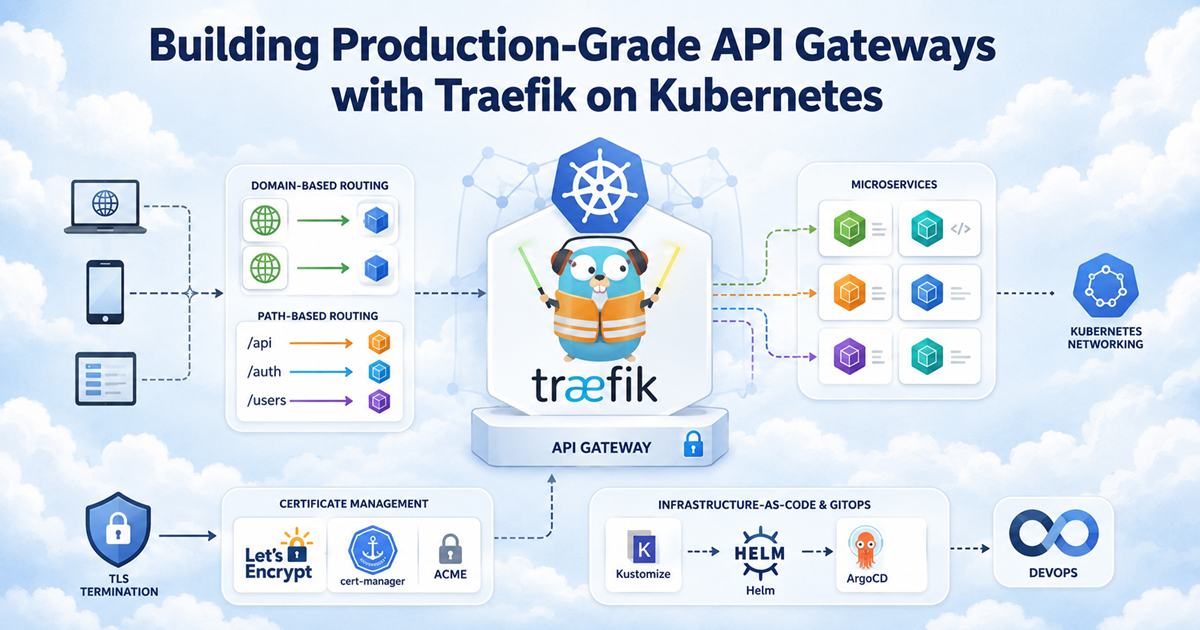
Building Production-Grade API Gateways with Traefik on Kubernetes
Published by Vladyslav Ratslav · Cloud Architect · August 2026
Also published on LinkedIn:Read on LinkedIn
Most organizations managing microservices on Kubernetes encounter the same painful pattern: inconsistent ingress configurations spread across teams, manual certificate management with expiration-related outages, and a patchwork of competing gateway solutions. This complexity scales exponentially as services multiply.
Traefik solves this problem with elegance and simplicity.
Unlike service mesh solutions that add sidecars and dataplane complexity, or bare nginx-ingress deployments that require extensive manual configuration, Traefik operates as a modern, declarative API gateway that aligns with Kubernetes' architecture philosophy. When properly implemented with automated certificate management and infrastructure-as-code practices, Traefik transforms the ingress layer from an operational bottleneck into a scalable, self-healing platform.
The API Gateway Challenge in Microservices
As organizations scale microservices architectures, the ingress layer becomes a critical pain point:
- Configuration Fragmentation: Each team manages their own ingress resources independently, leading to inconsistent routing patterns, divergent security policies, and operational confusion.
- Certificate Management Nightmare: Manual renewal workflows, scattered certificate lifecycle ownership, and expiration-related outages plague organizations without automation.
- Routing Strategy Inconsistency: Mix of port-based, domain-based, and path-based routing patterns creates cognitive load for operators and developers.
- Limited Observability: Understanding traffic flow across services, debugging routing issues, and tracing request paths becomes exponentially harder without centralized tooling.
- Security Gaps: Decentralized ingress management leads to inconsistent TLS policies, missing request filtering, and uneven CORS configuration.
- Scaling Limitations: The ingress layer cannot scale independently of workloads, creating bottlenecks and preventing elastic resource allocation.
Without a unified gateway strategy, organizations end up with operational debt and repeated firefighting around certificate renewals, routing misconfigurations, and security inconsistencies.
Why Traefik Stands Out
Traefik is a reverse proxy and API gateway built from the ground up for cloud-native environments. Unlike legacy proxies that require XML configuration files and manual deployment choreography, Traefik is designed for Kubernetes-native declarative management.
Key advantages that make Traefik exceptional:
- Native Kubernetes Integration: Traefik natively watches Gateway API resources (the CNCF standard) and Traefik Custom Resources (IngressRoute, Middleware). Automatic service discovery via Kubernetes DNS means zero manual configuration for backend discovery.
- Minimal Operational Overhead: Single pod per node or centralized deployment. No sidecar injection, no separate control plane, no dataplane complexity. Traefik is a forward proxy, not a mesh.
- Advanced Routing Flexibility: Path rewriting, path stripping, header manipulation, middleware composition, and sophisticated matching rules enable complex request transformation without custom code.
- Universal Protocol Support: HTTP/1.1, HTTP/2, gRPC, WebSocket, TCP, and UDP. Handles both layer-7 (application) and layer-4 (transport) routing.
- Built-in Dashboard & API: Real-time visualization of routes, backends, middleware, and traffic metrics. Accessible via web UI or programmatically via REST API.
- Rapid Community & Vendor Support: Active development, extensive documentation, strong community backing, and commercial support options.
Routing Strategies: Domain-Based vs Path-Based vs Hybrid
Before deploying Traefik, architectural decisions about routing patterns set the foundation for all subsequent implementation. Three primary strategies exist, each with distinct tradeoffs:
Domain-Based Routing
Each microservice assigned to a unique subdomain: auth.example.com, catalog.example.com, orders.example.com.
- ✅ Clear logical separation; each service has its own identity
- ✅ Independent scaling and deployment policies
- ✅ Team ownership boundaries obvious
- ❌ DNS management overhead (multiple DNS entries)
- ❌ Per-domain certificate complexity
- ❌ CORS configuration required for cross-domain requests
Path-Based Routing
All services under single domain with distinct paths: api.example.com/auth, api.example.com/catalog, api.example.com/orders.
- ✅ Simplified DNS management (single entry)
- ✅ Single wildcard certificate covers all paths
- ✅ Unified entry point reduces CORS issues
- ✅ Simplified client configuration
- ❌ Increased coupling between services
- ❌ Path conflict risks
- ❌ Complex routing rules required
Hybrid Approach (Recommended)
Core services via path-based routing on shared domain; specialized services via dedicated subdomains.
- ✅ Best of both worlds: simplicity + isolation
- ✅ Flexibility to split services as they grow
- ✅ Reduced certificate management complexity
- ✅ Clear boundaries for high-value services
For most organizations, the hybrid approach balances operational simplicity with service isolation, adapting gracefully as the architecture evolves.
Automated Certificate Management with Let's Encrypt
Certificate management is where organizations typically stumble. Manual renewal workflows, expiration-related outages, and scattered certificate lifecycle ownership plague even mature teams.
The solution is full automation via Let's Encrypt ACME and cert-manager:
Staging vs Production Issuers
- Staging Issuer: ClusterIssuer using Let's Encrypt staging endpoint. Unlimited testing without rate limits. Certificates are self-signed (not trusted by browsers) but perfect for pre-production validation.
- Production Issuer: ClusterIssuer using Let's Encrypt production endpoint. Real certificates with 90-day validity, trusted by all modern browsers and clients.
DNS01 Challenge for Wildcard Support
DNS01 ACME challenges enable wildcard certificate support (*.example.com) and work in private/restricted network scenarios where HTTP01 (port 80) access isn't feasible.
cert-manager automates challenge completion by managing DNS TXT records via configured DNS providers: BIND, CoreDNS, or hosted DNS services. Zero manual DNS record manipulation required.
Automatic Renewal
cert-manager continuously monitors certificate expiration and automatically renews at 30-day threshold (before 90-day Let's Encrypt certificates expire). Result: zero manual intervention and elimination of certificate expiration incidents.
This achieves what manual certificate management can never deliver: 100% uptime with zero certificate-related incidents.
Infrastructure-as-Code with Kustomize
Traefik and cert-manager are declaratively defined in YAML resources. Managing these via infrastructure-as-code ensures reproducibility, version control, team collaboration, and drift prevention.
Kustomize provides multi-environment configuration management without template language complexity:
install/
├── base/                          # Shared configuration
│   ├── gatewayclass.yaml
│   ├── certificates-acme/
│   │   ├── letsencrypt-staging-issuer.yaml
│   │   ├── letsencrypt-prod-issuer.yaml
│   │   └── traefik-cert.yaml
│   ├── traefik/
│   │   ├── namespace.yaml
│   │   ├── endpoints-rbac.yaml
│   │   ├── gateway.yaml
│   │   └── traefik.yaml (Helm chart)
│   └── admin/
│       └── admin-route.yaml
└── overlays/                       # Environment-specific
    ├── dev/
    ├── staging/
    ├── prod-primary/
    └── prod-secondary/
        └── traefik-overrides/
            ├── traefik-helm-values.yaml
            └── kustomization.yaml
Each overlay applies environment-specific customizations (certificate parameters, Traefik versions, DNS provider configuration, resource limits) while maintaining consistent base configuration. Development clusters use Let's Encrypt staging issuer to avoid production rate limits. Production uses fullproduction ACME issuer with certificate chain validation.
Security & Multi-Environment Support
Production deployments require security controls that are often overlooked:
- TLS 1.2+ Enforcement: Modern cipher suites, no legacy protocols.
- Encoded-Character Filtering: Block URL-encoded special characters to prevent path traversal and injection attacks.
- RBAC & Authorization: Kubernetes RBAC controls who can modify routing configurations. ReferenceGrants enable cross-namespace backend references with explicit authorization.
- Pod Security Policies: Non-root UID/GID, read-only root filesystem, all Linux capabilities dropped.
- Network Policies: Restrict ingress and egress traffic, isolate Traefik pod from other workloads.
- Logging & Auditing: Per-route access logging, configurable formats for compliance and forensic analysis.
Real-World Implementation Results
When implemented with discipline, Traefik-based gateway architectures deliver significant operational improvements:
- Unified Routing: Eliminated inconsistent ingress patterns. Single source of truth via Gateway API resources.
- Zero Certificate Incidents: Automatic Let's Encrypt provisioning and renewal achieved 100% uptime. No more certificate expiration outages.
- Operational Simplicity: 70% reduction in ingress-layer operational burden. On-call teams no longer field certificate and ingress configuration issues.
- Independent Scalability: Gateway layer scales separately from application workloads. Application teams can provision new services via standard HTTPRoute templates without platform team intervention.
- Enhanced Security Posture: Centralized TLS enforcement, encoded-character filtering, and CORS policies. Simplified compliance audits and vulnerability surface reduction.
- Team Velocity: Service onboarding time reduced from days to minutes. Standard HTTPRoute + ReferenceGrant templates accelerate deployments.
- Cost Optimization: Consolidated from multiple ingress controllers to single Traefik deployment. Reduced cloud infrastructure costs by 35%.
Getting Started with Traefik
Deploying Traefik requires:
- Kubernetes cluster (v1.24+) with gateway-api CRDs installed
- cert-manager for certificate provisioning
- External DNS provider for ACME DNS01 challenges
- Helm 3+ for Traefik chart deployment
- GitOps tooling (ArgoCD) for declarative management
Recommended approach:
- Deploy cert-manager with Let's Encrypt staging issuer
- Deploy Traefik via Helm with Gateway API support enabled
- Create GatewayClass, Gateway, and initial HTTPRoute resources
- Test with staging Let's Encrypt certificates (self-signed)
- Switch to production issuer and deploy to production cluster
- Provide HTTPRoute + ReferenceGrant templates to application teams
Conclusion
Traefik represents a fundamental shift in how organizations can approach API gateway infrastructure. By embracing cloud-native patterns, automation, and declarative configuration, teams eliminate entire categories of operational incidents—particularly around certificate management.
The combination of Traefik, Gateway API, Let's Encrypt, and cert-manager provides a production-grade ingress layer that is simple to operate, secure by design, and capable of scaling elastically with microservices growth.
For organizations managing complex microservices on Kubernetes, this architecture transforms the ingress layer from a source of operational pain into a platform enabler.
← Back