
Elastic Beanstalk: The Most Underrated AWS Service for Fast, Reliable Deployments
Published by Vladyslav Ratslav · Cloud Architect · June 2026
Also published on LinkedIn:Read on LinkedIn
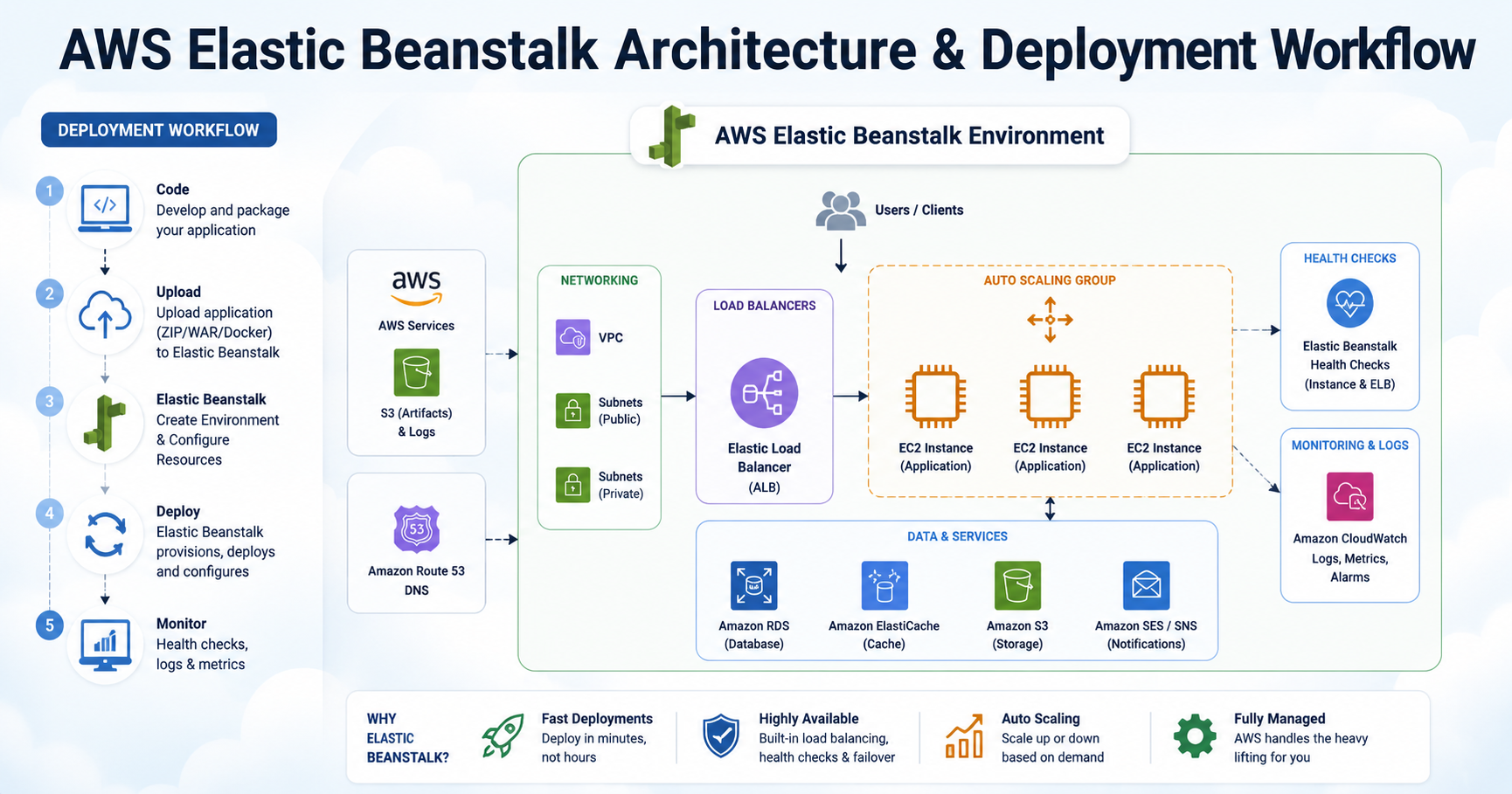
Elastic Beanstalk (EB) is one of the most powerful — and most overlooked — services in AWS. For startups, small teams, and early‑stage products, it delivers something incredibly rare: production‑grade infrastructure without the operational overhead. EB lets you deploy server‑side applications in minutes, skipping the tedious setup of EC2 provisioning, load balancers, networking, scaling groups, health checks, and deployment workflows.
It’s the closest thing AWS has to “Heroku‑level simplicity with AWS‑level power.”
Why Elastic Beanstalk Is So Effective
Elastic Beanstalk gives you a fully managed environment that automatically handles:
- EC2 provisioning
- Load balancers (ALB/ELB)
- Auto‑scaling groups
- Route53 integration
- RDS database provisioning
- SQS worker environments
- CloudWatch logs & metrics
- Rolling, immutable, and blue/green deployments
All of this comes out of the box, without writing a single line of infrastructure code.
For early‑stage products, this is a superpower: you can deploy a real backend in minutes, not weeks.
Cost Efficiency: From $10–15/month to Enterprise Scale
One of the biggest advantages of EB is its cost flexibility:
- A minimal environment (t3.micro + ALB) can run for $10–15/month
- You can scale up to multi‑AZ, multi‑instance, high‑availability setups
- Auto‑scaling rules allow you to pay only for what you use
- You can attach EB to a shared ALB to reduce costs even further
This makes EB ideal for:
- MVPs
- Startups
- Internal tools
- Admin dashboards
- Low‑traffic APIs
- Early‑stage SaaS products
And when you grow, EB grows with you — without rewriting your architecture.
Language & Runtime Flexibility
Elastic Beanstalk supports:
- Node.js
- Python
- PHP
- Ruby
- Java
- .NET
- Go
- Docker (single or multi‑container)
Docker support is the real game‑changer: If it runs in a container, Elastic Beanstalk can run it.
This means you can deploy: Next.js, FastAPI, Laravel, Django, Express, custom microservices, background workers, and anything containerized.
Why IaC Is Mandatory for Long‑Term Success
You can create an EB environment from the AWS Console or CLI — and it will work. But the moment you need:
- multiple environments (dev/stage/prod)
- reproducibility
- long‑term maintenance
- team collaboration
- drift prevention
…console‑created EB becomes a nightmare. That’s why the industry standard is to manage EB using Infrastructure as Code, especially Terraform.
resource "aws_elastic_beanstalk_application" "web" {
  name = "web-${var.env}"
}

resource "aws_elastic_beanstalk_application_version" "web" {
  name        = "${var.env}-web-v1"
  application = aws_elastic_beanstalk_application.web.name
  bucket      = aws_s3_bucket.eb_artifacts.id
  key         = aws_s3_object.initial_app.key
}

resource "aws_elastic_beanstalk_environment" "web" {
  name                = "web-${var.env}"
  application         = aws_elastic_beanstalk_application.web.name
  solution_stack_name = var.eb_api_solution_stack_name

  version_label = aws_elastic_beanstalk_application_version.web.name

  lifecycle {
    ignore_changes = [version_label]
  }

  # ... (full configuration omitted for brevity)
}
With Terraform, you gain reproducible environments, easy cloning for dev/stage/prod, version control, automated deployments, drift elimination, and team collaboration.
Why I Recommend Elastic Beanstalk for Startups
For early‑stage companies, the priorities are: speed of development, speed of delivery, low cost, minimal DevOps overhead, and the ability to scale later without rewriting everything.
Elastic Beanstalk hits all of these perfectly. It gives startups a production‑ready backend without needing Kubernetes, ECS, EKS, or complex infrastructure. And when the product grows, EB can scale horizontally, vertically, and across AZs with almost no effort.
This is why EB remains one of the most practical, cost‑efficient, and startup‑friendly AWS services.
← Back